Redefining my writing workflow

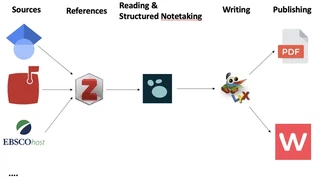
One of the things I have started recently is a book-project. For this purpose I have been working on a new writing workflow which combines reference management, reading, highlighting and note-taking, writing and publishing. In this short post I will try to describe the setup and workflow.
My book-writing workflow in detail
- Sources: Of course, the basis of all writing is reading :-). To identify prior work and to get an overview about the domain I have collected approximately 80 sources which I have started to read. These sources are mainly journal articles, some are books and book-chapters. I mostly start with GoogleScholar and combine it with some meta-databases like EBSCOHost, but I also appreciate article newsletters from journals (and can recommend the VUB Paperboy for our domain). The list of potential sources to identify related work is of course endless and I want to try in the future AI services like Researchrabbit or Elicit (which I both got to know through conversations with Yanay Zaguri: Thanks!).
- Reference management: I have switched some years ago from Mendely to Zotero and besides a little outdated interface I really appreciate the reliability and extendability of Zotero. I can recommend for example the extension BetterBibTex. The extension takes for example care for renaming PDF and sorting them into a specific folder. In general, Zotero works great in importing references from the web and it can for example also generate references to books based on ISBN-numbers. You can easily collect a nice list of well-formated references.
- Reading and structured notetaking: Logseq has really changed the way I read papers and take notes about them. As described in an earlier post about my PKM the PDF-reader and annotation environment is perfect for taking structured notes. The nice thing is, that I can directly access papers from Zotero. I can start a paper from my database and open it on the left side of the screen while I have a chapter structure for my book-projekt as an outline on the right side. Whenever I think something fits into this structure I can either mark and shift pieces of text from left to rigth, or I can note down ideas for chapters.
- Writing: My main target format for the book is a well-formatted PDF. Due to this requirement I am using LyX as a visual editor which can produce nicely formatted documents via LaTeX. Again, the interface looks a little outdated, but the functionaliy is really great. LyX can access directly my reference libary from Zotero and has sufficient styling options to produce a nice looking text.
- Publishing: As already mentioned, one important output format is a PDF file. This is the standard format of the editor I am using for writing. At the same time, I would like to produce a web-version of the text. For this purpose I have configured LyX to produce MarkDown files from the same text which I can easily integrate into my website which is running on the basis of Wowchemy. Via this route I can easily give people access who can provide feedback to the chapters during the writing process.

I am a researcher in educational technology whose work explores how digital technologies reshape learning, teaching, and educational institutions. My research combines educational technology, learning sciences, feedback research, and critical perspectives on digital transformation.Current areas of interest include peer feedback and feedback literacy, open and networked learning, AI and misinformation in education, digital learning ecologies, and the societal implications of data-driven and platform-based education. Methodologically, my work spans empirical learning research, psychometric scale development, design-oriented research, and conceptual analyses of digital transformation in education.
I am working as a full professor of educational technology and Chief Information/Chief Digital Officer (CIO/CDO) at the Heidelberg University of Education. I serve as associate editor of the International Journal of Artificial Intelligence in Education and editorial board member of the Journal of Computing in Higher Education. I am a senior-fellow of the Interuniversity Center for Educational Sciences (ICO) and the Dutch research school on information and knowledge systems (SIKS). I work as director of the study program E-Learning and Media Education and director of the Heidelberg Centre for Digital Transformation in Education. Over the years I could secure approx. 4 Mio EUR of research funding for my institutions from competitive projects with a total budget of 36 Mio EUR. I have been an invited keynote speaker on more than 60 conferences and events. Besides European projects I am regularly involved in educational innovation and consulting projects with partners inside and outside of my institutions including clients like the International Labour Organisation, United Nations Environment Program, the European Commission, UNESCO, OECD or other international and national organizations.