Bildungdigital21

A new direction for the German digital education strategy?
The German government has organized on the 22nd of February 2021 an online-event regarding a future strategy on digital education. The event was a mix of political intention statements and some advertisement of existing initiatives. What I found remarkable was that there is still the vision, that any overarching OER platform would solve any problems with education despite this has failed on the European level already many years ago. The video of the discourse is embedded below.
# We first install the Youtubecaption library
install.packages('youtubecaption')
# Now we import the captions from the video
library(youtubecaption)
library(quanteda)
library(tidyverse)
url <- "https://www.youtube.com/watch?v=WAlP39a5LUU"
caption <- get_caption(url, language ="de")
caption
# Now we need to make a document-term-matrix from the content
my_corpus <- corpus(caption$text)
summary(my_corpus)
# Extending the stopwordlist with a more extended one from Github
ger_stopwords <- read_lines("https://raw.githubusercontent.com/stopwords-iso/stopwords-de/master/stopwords-de.txt")
custom_stopwords <- setdiff(ger_stopwords, stopwords("german"))
# Constructing the
meine.dfm <- dfm(my_corpus, remove_numbers = TRUE, remove_punct = TRUE, remove = c(stopwords("german"), custom_stopwords))
meine.dfm.trim <- dfm_trim(meine.dfm, min_docfreq = 1, min_nchar = 3)
# Visualizing the matrix
textplot_wordcloud(meine.dfm.trim, min_size = 1, max_size = 2, max_words = 100)
This code takes the full transcript from youtube, builds a corpus, removes stopwords and visualizes the most frequent words in the resulting tagloud.
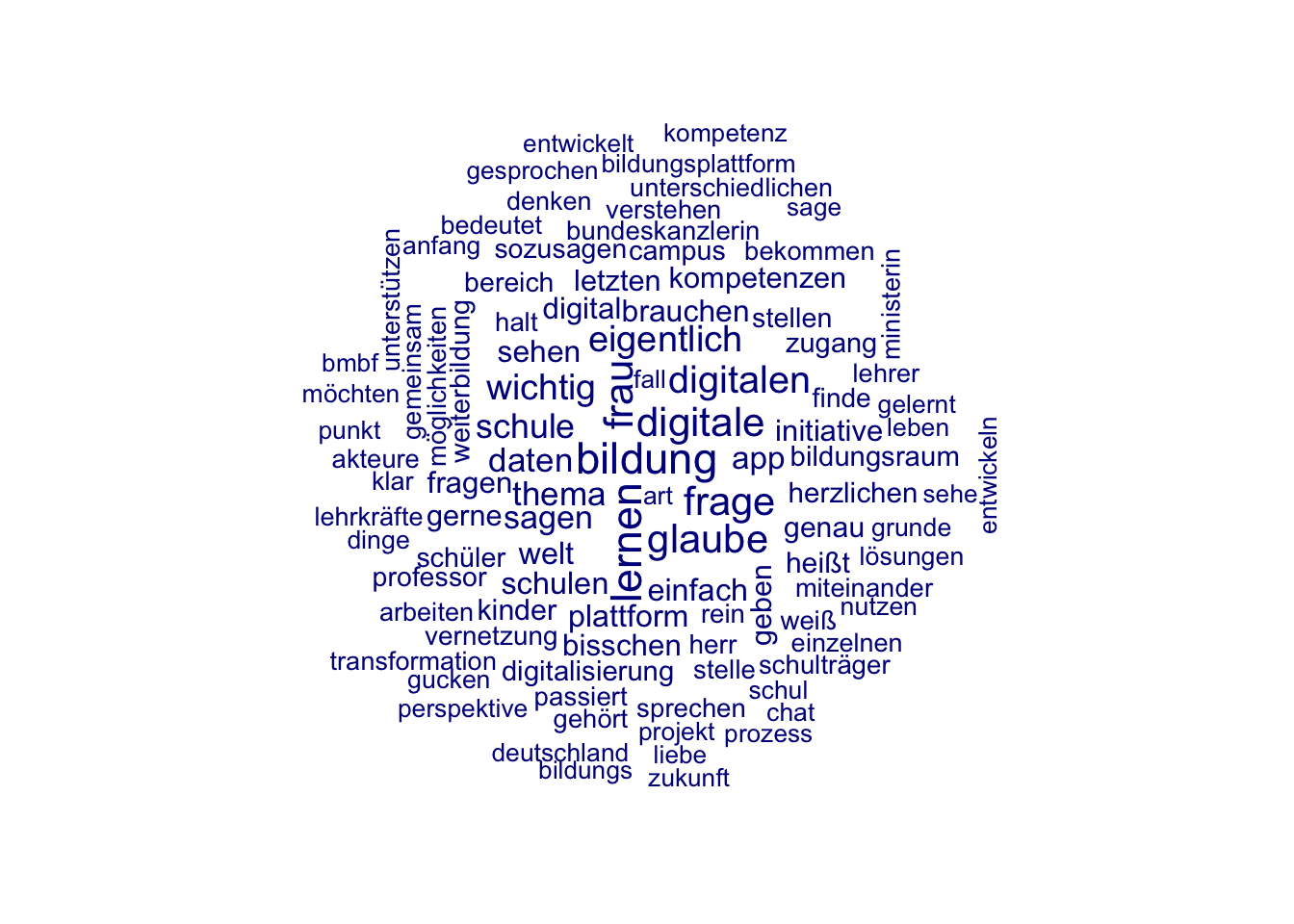
Tagcloud from the event

I am a researcher in educational technology whose work explores how digital technologies reshape learning, teaching, and educational institutions. My research combines educational technology, learning sciences, feedback research, and critical perspectives on digital transformation.Current areas of interest include peer feedback and feedback literacy, open and networked learning, AI and misinformation in education, digital learning ecologies, and the societal implications of data-driven and platform-based education. Methodologically, my work spans empirical learning research, psychometric scale development, design-oriented research, and conceptual analyses of digital transformation in education.
I am working as a full professor of educational technology and Chief Information/Chief Digital Officer (CIO/CDO) at the Heidelberg University of Education. I serve as associate editor of the International Journal of Artificial Intelligence in Education and editorial board member of the Journal of Computing in Higher Education. I am a senior-fellow of the Interuniversity Center for Educational Sciences (ICO) and the Dutch research school on information and knowledge systems (SIKS). I work as director of the study program E-Learning and Media Education and director of the Heidelberg Centre for Digital Transformation in Education. Over the years I could secure approx. 4 Mio EUR of research funding for my institutions from competitive projects with a total budget of 36 Mio EUR. I have been an invited keynote speaker on more than 60 conferences and events. Besides European projects I am regularly involved in educational innovation and consulting projects with partners inside and outside of my institutions including clients like the International Labour Organisation, United Nations Environment Program, the European Commission, UNESCO, OECD or other international and national organizations.